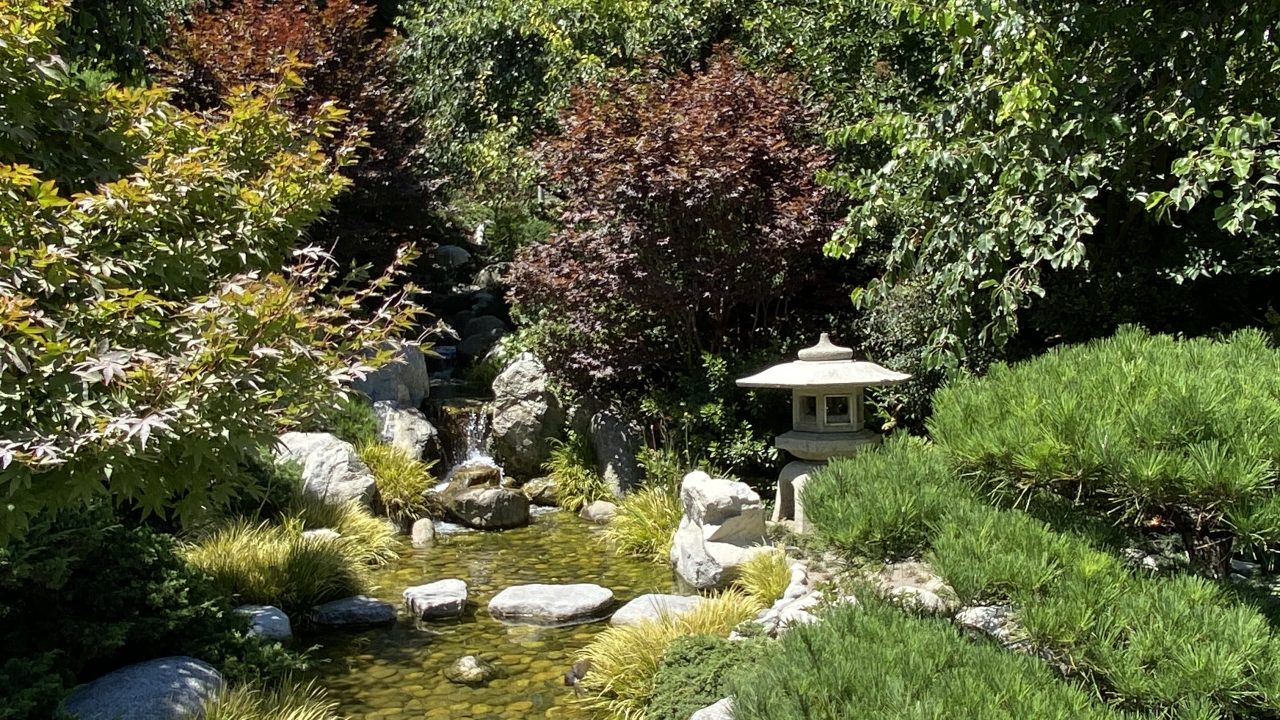
The Japanese Friendship Garden in Balboa Park, San Diego and a great place to visit if you love garden design and Japanese style.
The Japanese Friendship Garden and Museum (JFGM) in Balboa Park, San Diego, exemplifies centuries of Japanese garden design tenets while adapting to the dry Mediterranean climate of San Diego. After planning and fundraising since 1955, the JFGM opened in 1991 as an expression of friendship between San Diego and her sister city in Japan, Yokohama.
The second phase, designed by famous landscape architect Takeo Uesugi, opened in 1999. It included the exhibit hall, activity center and upper koi pond. The third phase, completed in 2015, included a 200 cherry tree grove, an azalea and camellia garden, the Inamori Pavilion, and a water feature modeled after a San Diego watershed.
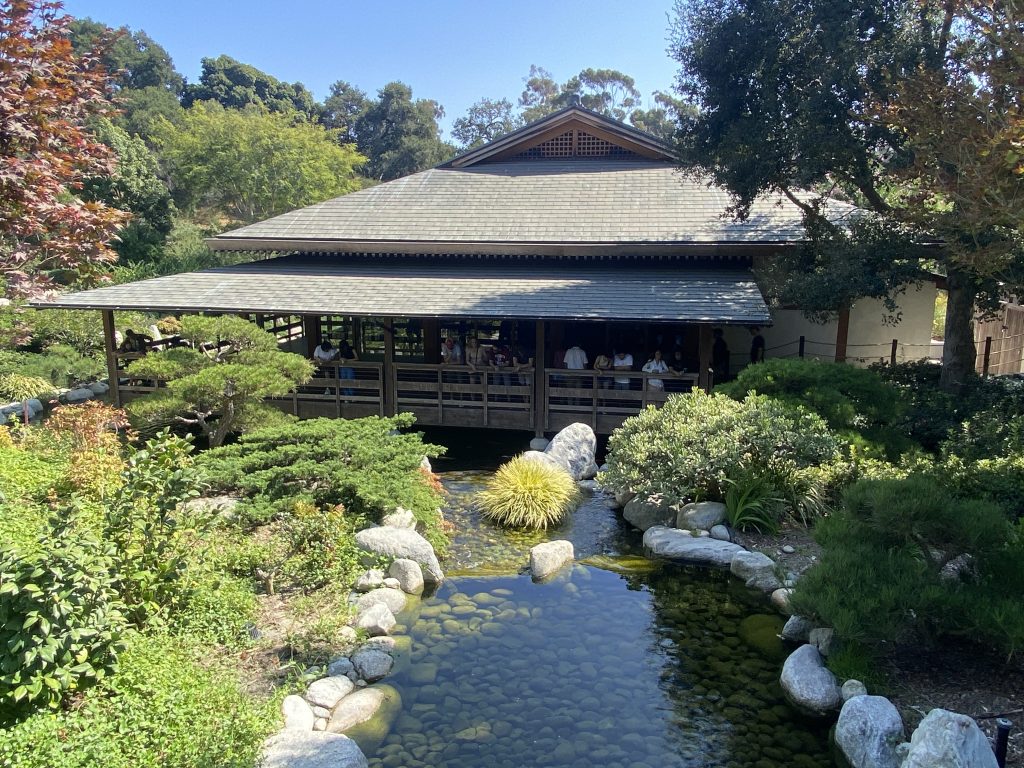
The JFGM covers 12 acres and its name in Japanese is San-Kei-En, which means three scenes–water, pastoral, and mountain–garden. It is not a botanical garden because none of the plants are labeled. Learning is not the goal, it is a place to escape the pressures of city life. Daoist and Shinto ideals emphasize living in harmony with nature rather than conquering and naming it.
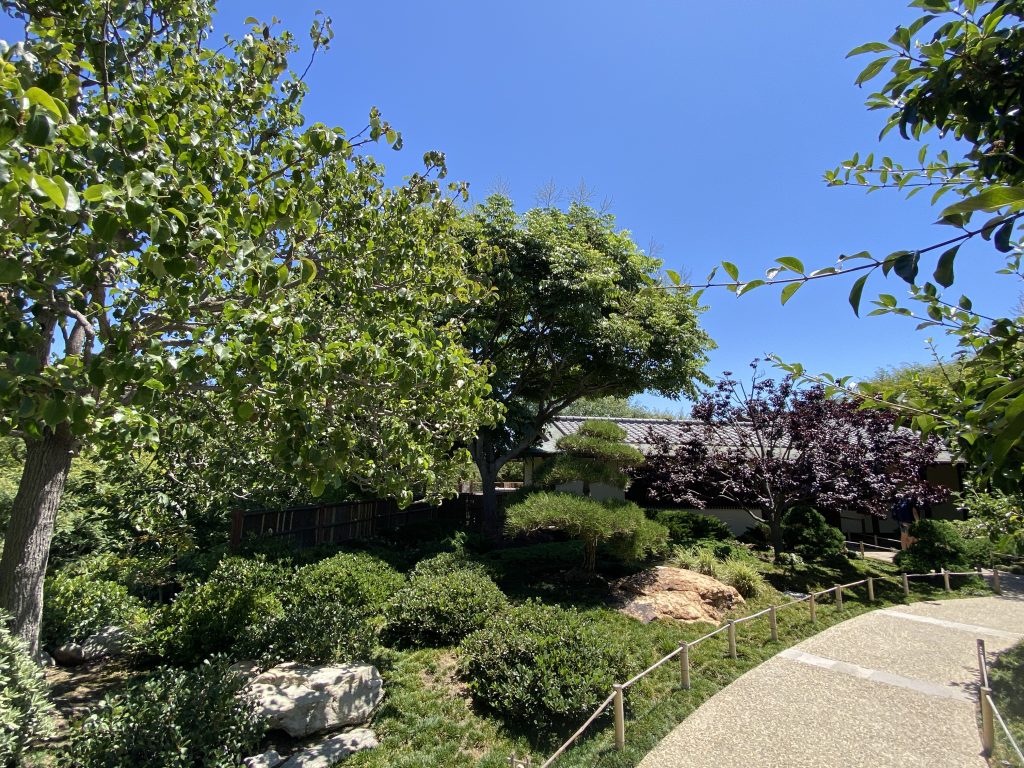
The garden’s entrance is next to the Spreckels Organ Pavilion, but most of its acreage slopes down into a canyon. This topography provides opportunities for mountain esthetics. Although the garden does not contain a tea house, the upper garden has roji elements. Upon entering the garden, the path, made of pebble-deck, is lined with plantings of dwarf mondo grass, black pine, and shade trees. Boulders provide focal points and bamboo hides the fence. The path goes around a corner, hidden with a purple plum tree, to the exhibit hall which is where a tea house would be located.
Japan has a strong cat culture so it is auspicious that a resident tuxedo cat, named mouse, often greets visitors. A true roji garden would have stepping stones and moss, but moss requires a wetter climate and stepping stones aren’t ADA compliant. The large shade trees are Tipus and Fern Pines, natives of South America and Africa, but common throughout San Diego because of their low water needs.

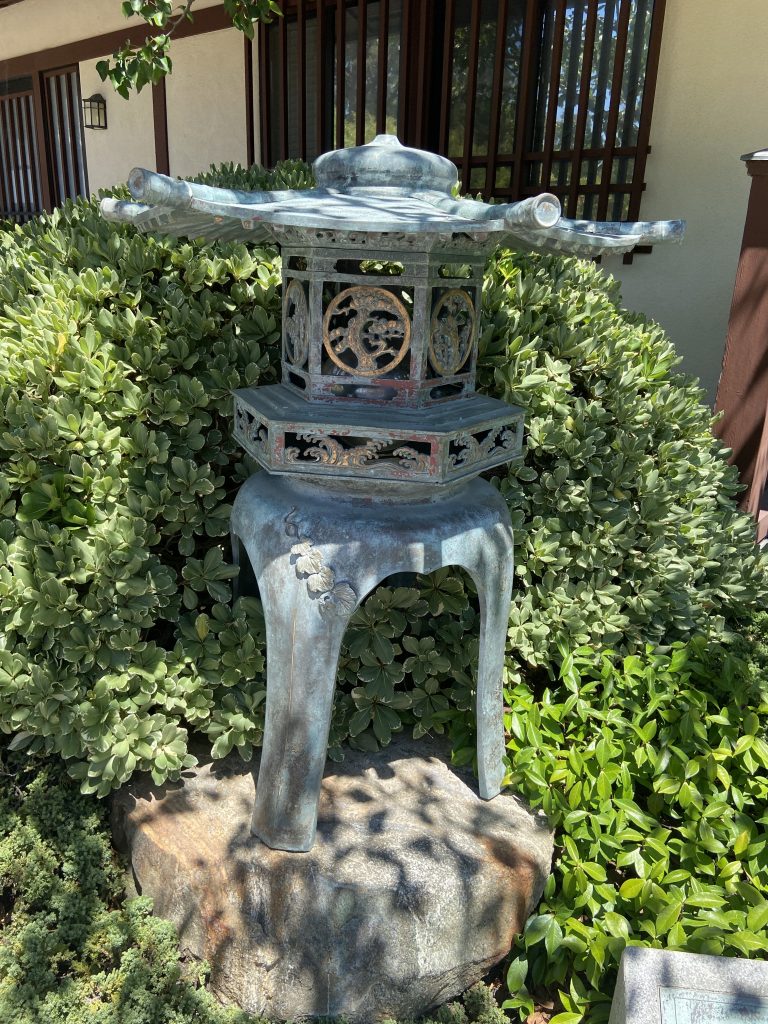
After the museum, the path opens onto a plaza with an arbor covered in Japanese wisteria and furin wind bells. In Japan, wisteria symbolizes love and longevity. On the side is the bronze Friendship Lantern which was a gift to the garden from a Boy Scout troop in Yokohama. There is also a bonsai exhibit and Zen garden of raked pebbles and stones.
The entrance to the lower garden is marked with the Charles C. Dail Memorial Gate. It was built in the Meiji style for the Storrier Sterns Japanese Garden in Pasadena in the 1930s. It was sold to the City of San Diego in the 1970s. It was renamed after the former San Diego mayor who established the Sister City Association with Yokohama.

The JPFM is primarily a stroll garden. The stroll garden developed during Japan’s Endo period (1603-1867). Kobori Enshi, tea master, was the leading garden designer. His goal was to create a kinetic experience of landscape through zigzag paths leading to “hide and reveal” scenes. The philosophy was called Kirei Sabi, elegant beauty infused with rustic quality. The key elements of Japanese garden design are: abstract compositional harmonies, elegant rusticity, borrowed views, asymmetrical configuration of design elements, sacred rocks, and attention to the ground plane. All of these elements are in the JFGM.
The top path gradually slopes down to the canyon in a zigzag path made of decomposed granite. The view is obscured by shade trees and the slopes are covered with Indian Hawthorn. The rustic railing is made of wood and rope. Rest benches are placed so that they face a specimen tree, such as a Chinese magnolia, for contemplation. At certain points, the trees disappear and there is an expansive view. Using the design principle of shakkai, the garden “borrows” scenery from the rest of Balboa Park so that it appears larger and pastoral.
The JFGM contains elements of Japanese gardens such as stone lanterns and bridges. Two ponds contain koi fish, which symbolize longevity. Attention to the ground plane is typically shown with flat stepping stones. At the JFGM, this is modernized with the Zig Zag Bridge which is made of flat stones made into steps that descend asymmetrically.

Representing the friendship between Japan and San Diego, the plants are an interesting mix of Japanese plants and California natives. Japanese plants include Japanese maple, azaleas, camellias, black pines, junipers, flame tree, bamboo, camphor and gardenia. They are joined by San Diego natives such as the Coast Live Oak, sycamore, sagebrush and coast sunflower.
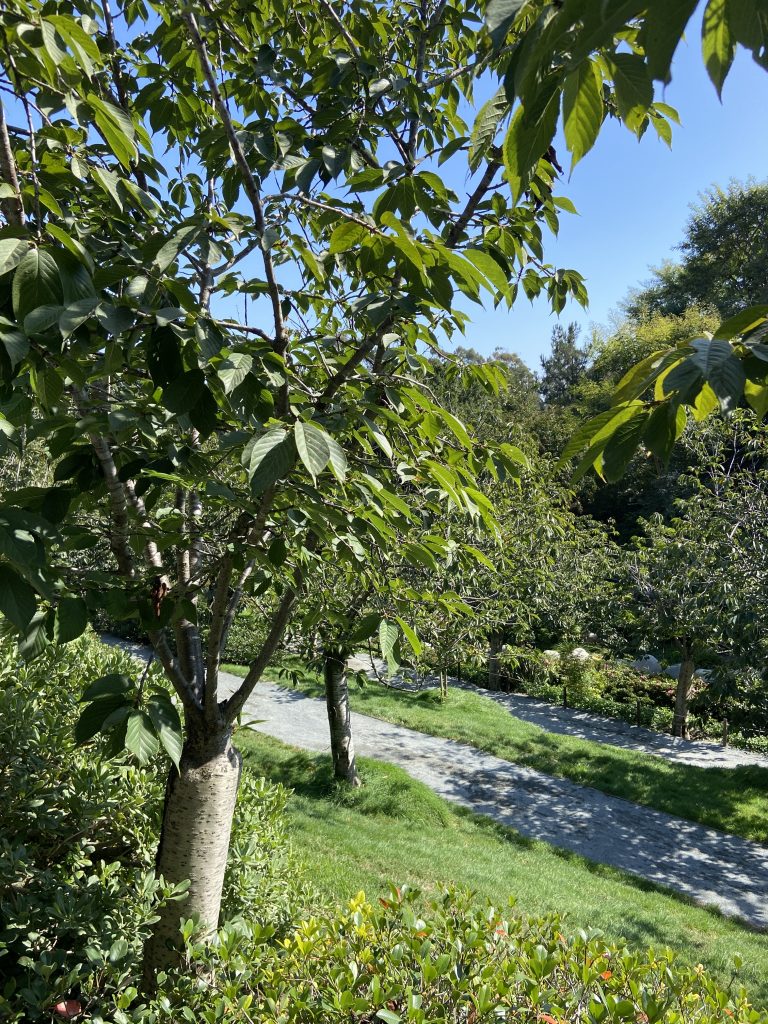
The garden had difficulty obtaining Japanese cherry trees because they won’t blossom in San Diego’s coastal climate. A special double hybrid graft cherry was developed for the JFGM. The garden struggled to find funding for its 200 cherry tree grove.
A Japanese woman named Mitoko donated a large sum. Mitoko had been orphaned by the atomic bomb in Nagasaki and had to drop out of school to work in the fields. An American ship, the USS Walke, was in Japan for repairs during the Korean war. The crew met the 14-year-old Mitoko and were charmed by her friendliness. They collected money and gave her a scholarship. She was able to become a nurse. Her donation for the trees was her way of paying back Americans for their kindness. This story makes the cherry trees a powerful symbol of forgiveness and humanity. Each year, the JFGM holds a cherry blossom festival in March.
The dry cascade waterfall encapsulates the design of the entire site. Most of the water in the garden is located near the bottom of the canyon. However, its source appears on the slope and is created with a dry cascade waterfall. This rock artistry is part of both Japanese and Chinese garden design. However, Japanese design favors flat rocks. It is an example of kare sansui composition and the absence of water suggests mu, or “no-thing-ness” which is part of Zen teaching.
However, this design feature also suits San Diego because it represents our local watersheds. Our eight rivers don’t flow in the summer and dry waterfalls occur throughout our local mountains. As the rock riverbed goes down into the garden, water emerges from it, as if from a spring. San Diego also has springs surfacing from the ground in areas such as Spring Valley. In the garden, water flows in a river through the bottom of the garden and into koi ponds. Instead of koi ponds, San Diego’s rivers flow into two estuaries, six lagoons and two bays. All of these water bodies are important areas for fish reproduction.

The river in the garden is bordered with jumbles of gray boulders. The Sakuteiki, by Tachibana no Toshitsuma (1028-1084), was the first garden manual and laid out the principles for Japanese design. It set rules for the handling of stones and setting stones in moving water for a river style. The book recommends that streams should flow east, and in the JFGM, the water does this. In San Diego, the rivers flow west, into the ocean. The design of the water in the JFGM, from its source as a dry cascade, to its end in a koi pond echoes San Diego’s watersheds while staying true to Japanese garden design.
Interested in garden styles? Check out my article Visit the Chinese Garden at the Huntington in Pasadena, CA.



Leave a Reply