Chicago prides itself on its architecture. Many people have heard of the Chicago River Cruise aboard the First Lady, offered by the Chicago Architecture Center.
But, the Windy City has many more architectural learning opportunities. Inside Chicago offers architecturally-themed tours that take walkers inside the buildings.
I took the “All that Glam Chicago’s Art Deco Masterpieces” Tour. My guide was an architect who could answer every question and taught me a new way to appreciate Art Deco buildings.
“Architecture is not based on concrete and steel and the elements of the soil. It’s based on wonder.”
Art Deco was popular during the 1920s and 1930s and has the following characteristics:
geometric patterns
emphasis of the vertical
symmetry
rich ornamentation
luxurious interiors
gilt
streamlined design
concrete covered plaques
Art Deco Expressed the Zeitgeist of the 1920s and 1930s
You can have a greater appreciation of art styles if you learn about the history and current events of the time period when it was created. For example, the spirit of Art Deco is abundance and excitement about technology. The 1920s were a modern age. A time when money was plentiful, technology was exciting, industry was boundless, and man’s potential was limitless.
“Architecture is the will of an epoch translated into space.”
–Miles van der Rohe, 20th century Modernist architect.
Jazz Age Social Hotspot: New Bismarck Hotel
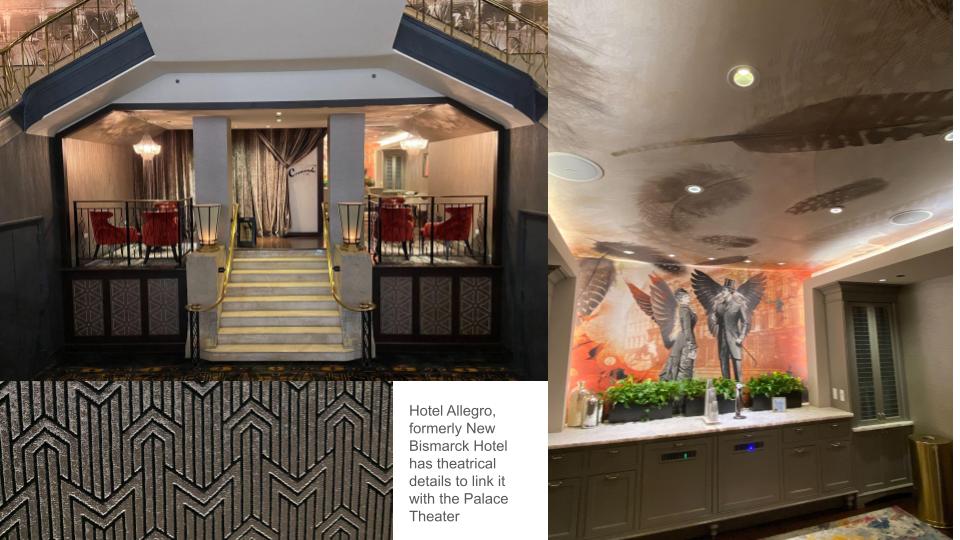
The Hotel Allegro, formerly called the New Bismarck Hotel, was constructed in 1924, by the Eitel brothers at 171 West Randolph Street. The Eitel brothers also built the Palace Theater next door, which is now the Cadillac Palace Theater. Rapp and Rapp Architects, which were famous for designing theaters and movie palaces designed both the hotel and theater.
The New Bismark Hotel was one of the hottest spots in Chicago and was the site of the first legal draft beer pour in Chicago. This signaled the end of Prohibition in 1933.
Remodeled in 2015 by the Kimpton group, the Hotel Allegro showcases the hotel’s Art Deco history and the influence of the theater. There is a sitting area resembling a stage and also wallpaper of theater-goers. The velvet wall paper has an Art Deco pattern.
The lighting fixtures are original. Eight chandeliers were found in the subbasement. They were fitted with LED lights to make them energy efficient.
One chandelier looks like it is made of hanging necklaces. Jazz age jewelry is echoed in the portrait of a flapper which is decorated with real gold and silver chains. Called Lady Lucent of Awakening, the flapper is a self-portrait of the artist, Sarah Raskey.
Autos and Roadtrips: The Chicago Motor Club
In the 1920s, new means of travel such as airships, automobiles and ocean liners enabled middle class people see the world, and the rest of the United States, for the first time.
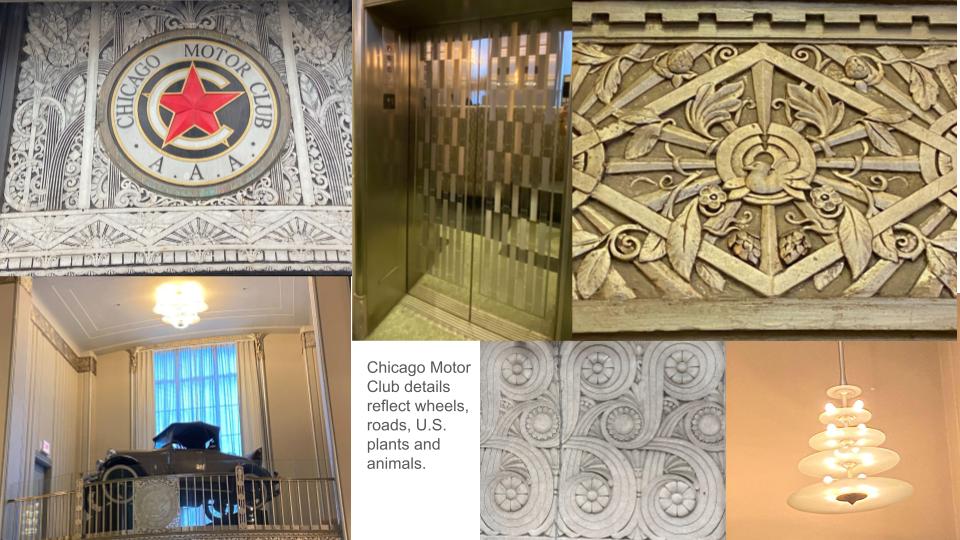
The Chicago Motor Club Building, at 68 E.Wacker Place, was the long-time headquarters of the Chicago Motor Club. It was built in 1928 and designed by Holabird and Root architects. It is an exceptional example of an Art Deco-style skyscraper. The interior decor remains intact, despite its repurposed use as a Hampton Inn.
The metal work shows plants and birds from around America. Geometric shapes are curved and evoke roads, wheels and motion. The elevator doors are stylized tire-tracks, and the lighting is wheel-inspired. The space captures the “modern” spirit of the 1920s, while a 1928 Ford Model-A car, along with historical photos, freeze that moment in history.
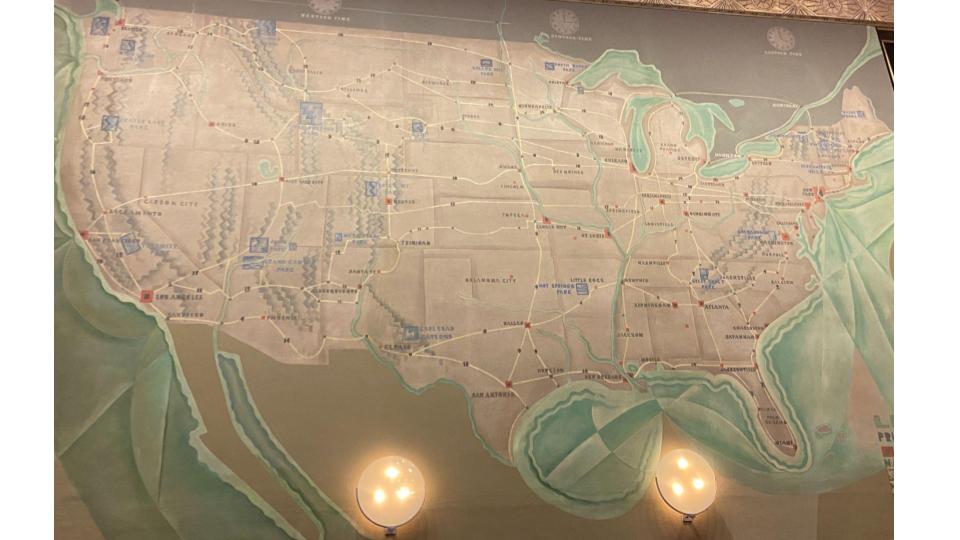
The show piece is the large-scale map mural of the United States and shows the 1920s-era transcontinental automobile routes. It was painted by Chicago artist John Warner Norton. The National Parks, newly accessible by automobiles, were popular destinations and are featured on the map.
Art Deco Details Tell a Story
Sculpture is an integral feature of Art Deco. This includes bas-relief, sculptural friezes and studio sculpture. The themes were chosen by the company paying for the building, and they wanted art to reflect the product/service they were selling or a sense of geographic place.
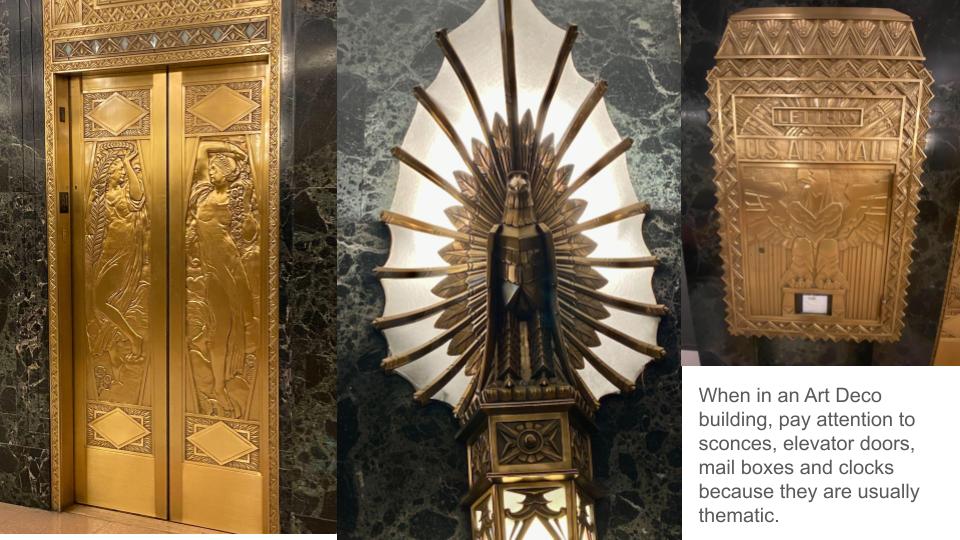
The tour guide told us to always look at elevator doors, sconces, and mailboxes in an Art Deco building because they usually show the building’s theme.
Chicago Pride of Place: One LaSalle Street Building
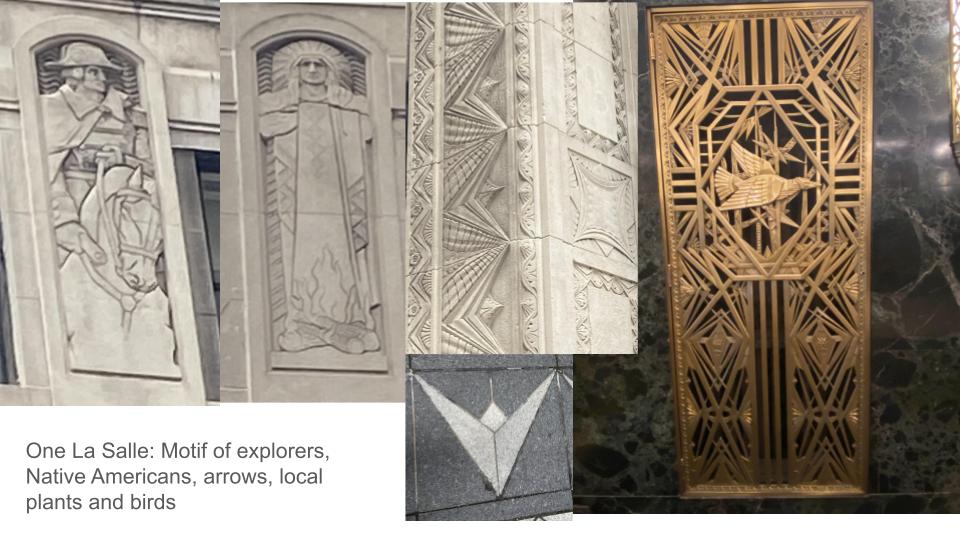
The One LaSalle Street Building was constructed on the presumed site of René-Robert Cavelier, Sieur de La Salle’s 17th century camp. La Salle was a French explorer and fur trader who explored the Great Lakes region and the Mississippi River.
Throughout the interior and exterior of the building, the motifs in metal and stone represent La Salle, explorers and Native Americans.
The magnificent sconces show the Thunderbird, an important character in Native American mythology. An enormous bird, it symbolized power and strength and protected humans from evil spirits. The Thunderbird brought rain and storms, both good and bad.
The mail box is custom and looks like it might be a thunderbird or stylized eagle. The main tenant of the building was a bank, and this is why the elevator doors show the Greek goddesses of Prosperity and Abundance.
Agricultural Bounty: Chicago Board of Trade
The Chicago Board of Trade Building was completed in 1930 and also designed by Holabird & Root. Situated at 141 W. Jackson St., it was the tallest building in Chicago until 1965.
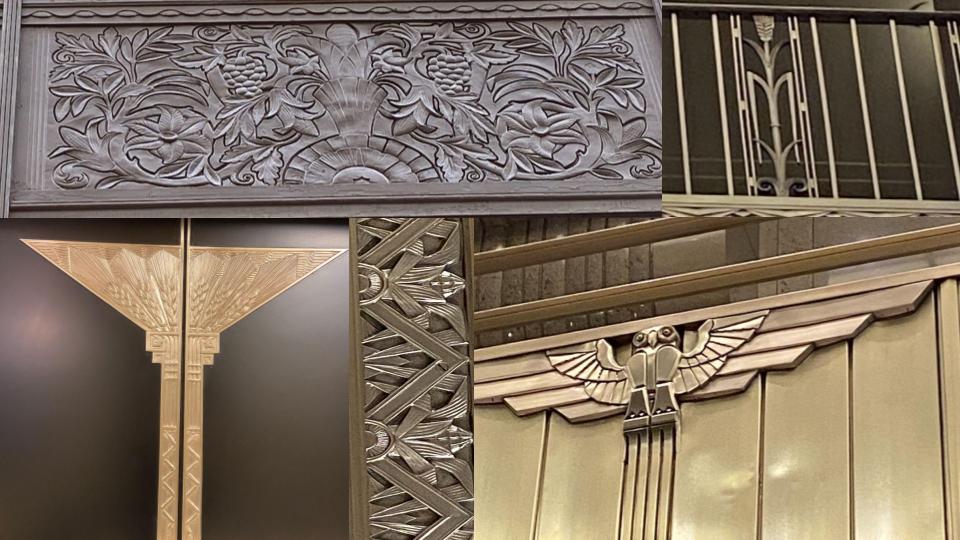
The Art Deco details reflect its role as the world’s largest grain exchange. Corn and sheafs of wheat are represented in the metal work and bas relief. The bird of choice is the owl, symbolic of wisdom, foresight and vigilance. Owls are also considered to be friends of farmers because they eat mice and pests.
The entrance has a huge clock flanked by a Mesopotamian farmer holding wheat and a Native American holding corn. Mesopotamia is considered to be the birthplace of agriculture and grew wheat and barley. Native Americans grew corn, the cereal crop of the New World.
Around the edges of the building are eight bovine heads. They are a reference to Chicago as the largest meatpacking center in the United States, beginning with the Civil War.
The Chicago Board of Trade is topped with a statue of Cerce by John Storrs. Ceres is the Roman Goddess of agriculture, grain and fertility. She is the equivalent of the Greek goddess, Demeter.
The reason there are often Greek/Roman goddesses is because Art Deco existed during the same period as the Neoclassical style which dominated European and American Architecture. Neoclassical architecture is based on the principles of simplicity and symmetry, which were seen as virtues of the arts in Ancient Rome and Ancient Greece.
Art Deco incorporated the symmetry and mythological art from Neoclassicism, but the goddesses often were depicted in a style emphasizing verticality. The Cereces statue is faceless and made of the modern material of Aluminum, rather than stone. She holds a sheaf of wheat in one hand and a grain sample bag in the other.
Conclusion
The happy mood of the 1920s changed suddenly in 1929 when the stock market crashed and the Depression began. New construction produced buildings that were more austere, without the gilt and luxury.
The government funded the construction of Federal buildings to create jobs. Fortunately, to employ craftsman and artist, they included Art Deco sculpture and visual art details. Federal architects needed to express the values of permanence, rationality and order. To do that, they used classic forms but streamlined them to suggest progress looking forward rather than looking backwards.
Most of the public buildings built as part of the New Deal had a similar look and are called WPA moderne.
You can read about the WPA moderne movement in my blogs about Nashville and San Diego Art Deco Treasures.
Love them or Fear them--Owls Appear in Mythologies all Around the World Owls appear in mythologies all around the world. Some cultures view them as omens of bad luck, sickness…
Frist Art Museum and the Davidson County Courthouse You might be in Nashville for the music, but take time to walk around and appreciate the architecture. The interiors of both…
Walking Tour for Art Deco Buildings in Coronado May is historic preservation month. This is the perfect excuse to take a walk and find the historic buildings in your city.…






Leave a Reply