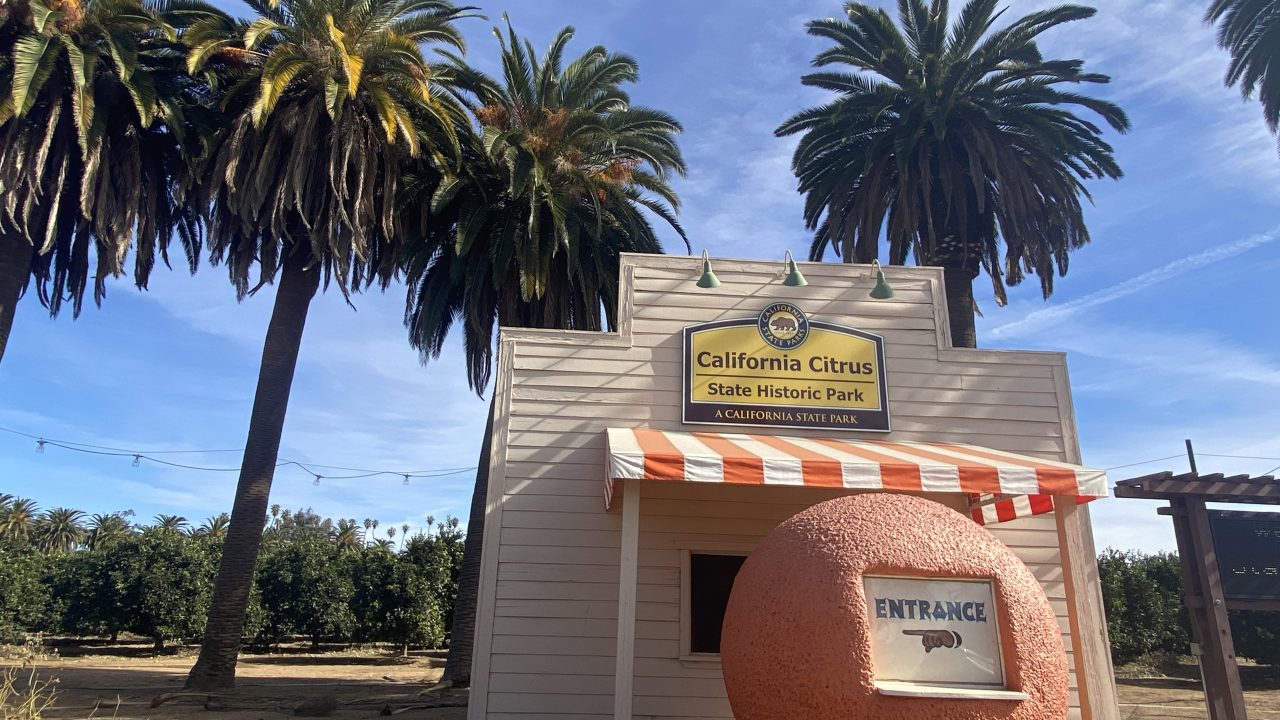
In Riverside, visit California Citrus State Historic Park, the parent Washington navel orange tree, the Heritage House and downtown Riverside. Discover how navel oranges and railroads cultivated the development of Southern California.
California and the Orange Empire
In 1870, the California orange crop revolved around the summer-ripening Valencia orange from Spain and originally grown at the California Missions. The introduction of the winter-ripening Washington navel orange, and the support of the transcontinental railroads, allowed California to dominate the citrus industry. In 1870, there were 30,000 orange trees in California, but by 1920, there were 10 million.
In 1895, Riverside, the heart of the Orange Empire, was the wealthiest city per capita in the nation. The Orange Belt spread to Pasadena, Los Angeles, San Gabriel Valley, and Orange County. Citrus, especially lemons, extended south to San Diego and north to Santa Barbara.
Orange Empire Takes Root in Riverside
The humble origin story of the Orange Empire began with two navel orange trees brought to Riverside by Eliza and Luther Tibbets in 1873. These two trees provided the cuttings from which all the Washington navels in California descended.
One of the original trees still grows in Riverside. You can see the parent Washington navel orange tree at 4526 Arlington Ave, Riverside. It is covered to protect it from pollution, insects and vandalism. The second tree was transplanted to the Mission Inn by President Teddy Roosevelt in 1904, but it died in 1922. Roosevelt visited the Orange Empire cities of Riverside and Redlands as part of his “wonders of the west” tour.

Eliza Tibbets the Mother of the Orange Empire
In 1870, a missionary in Brazil sent twelve grafted trees of the Bahia navel orange to the U.S. Department of Agriculture (USDA). William Saunders, head of the USDA, was friends with Eliza Tibbets and gave her two Bahia navel orange trees to try in the warm, arid conditions of Riverside in 1873.
Eliza famously watered the trees with her dish water–these were the days before irrigation. Riverside only receives about 9 inches of rain/year.

With Eliza’s care, the seedless orange trees thrived. They were renamed “Washington” navels to sound American. Navel orange trees must be grown by grafting cuttings onto root stocks. Eliza’s husband sold cuttings off of their trees to local farmers. It was a short-term business because once the farmers had successfully grafted the cuttings, they now had their own navel orange trees to use for propagation.
Eliza Tibbets and her husband are buried at Evergreen Memorial Historic Cemetery. Many of Riverside’s pioneers are buried there and it is worth a visit to see the old-fashioned headstones.

U.C. Riverside and Citrus Agriculture
All of the navel orange trees in California shared the same parentage because they were propagated through grafting, and Eliza’s trees were the original source. This is also the reason that citrus trees are susceptible to blights. All the trees have the same genetics.
Growing citrus was different from traditional farming. Jenkins, author of the Octopus’s Garden: How Railroads and Citrus Transformed Southern California, called the groves “industrialized botanical factories.” Landowners, typically wealthy easterners, embraced a scientific attitude towards farming.
In 1907, they lobbied the California government for a Citrus Experiment Station (which became the University of California, Riverside in 1959). The citrus pest called Cottony Cushion Scale was controlled by scientifically managing the groves. Experiments established picking and handling protocols to reduce decay and demonstrated the need for refrigerated boxcars.
Railroad Competition and Cooperation with Growers
Citrus growers benefitted when competition between the Southern Pacific and Santa Fe Railroads drove down shipping prices. These railroad companies also laid tracks to the orange groves so that citrus cooperatives, like Sunkist, could build packing houses on the main railroad lines.
By 1887, refrigerated railway cars were dedicated to citrus and California growers could export oranges to the Atlantic seaboard at cheaper rates than Florida growers could. Enjoying oranges from California affirmed Americans’ social status in the Gilded Age.
Railroad and citrus barons pressured both Federal and State governments to supply irrigation through water projects. Telegraph lines followed the railroad tracks, and hydroelectricity followed the dams.
The collaboration between the citrus growers and the railroads shaped land development in Southern California. Alongside the railroad lines built to serve the citrus groves, communities such as Redlands developed.
Oranges Become the New California Gold
Citrus crate labels played an important role in the public relations of both the railroads and citrus companies. Growers hired graphic artists to make crate labels so that California oranges and lemons stood out from Florida and Italian citrus products. The labels idealized California’s landscapes and its romantic Rancho-Mission history. The Citrus Label Gallery website shows 6,746 historic fruit crate labels.

In addition, the railroads sponsored citrus displays at expositions across the nation. Towers and landmarks were constructed out of oranges. Southern Pacific had a “California on Wheels” Campaign, and railway cars displaying citrus, nuts, and wines traveled across the United States. Train magazines, such as Sunset, carried advertisements for Southern California.

Santa Fe offered tourists the “Kite -Shaped Track” Excursion through the orange groves. This was a railway loop which carried tourists through the sweet scented orange groves of the Inland Empire. Passengers could disembark, tour the orange groves and see the mansions of the wealthy grove owners. The San Bernardino History and Railroad Museum had a section dedicated to the Orange Empire and railroads.
Visit the Heritage House
To glimpse the type of wealthy homes that used to line Magnolia Avenue in Riverside, visit the Heritage House. Built by a widow of a orange grove owner, in the 1890s, the home has been preserved in all its Queen Anne Victorian glory. The interior is distinctly feminine, with Greek goddesses adorning the fireplace and exotic art pieces sprinkled throughout.

Visit California Citrus State Historic Park Groves and Visitor Center
Visit California Citrus State Historic Park and walk through acres of orange groves to see many varieties of citrus and old farming equipment such as smudge pots. The visitor center tells the history of oranges and the Orange Empire.
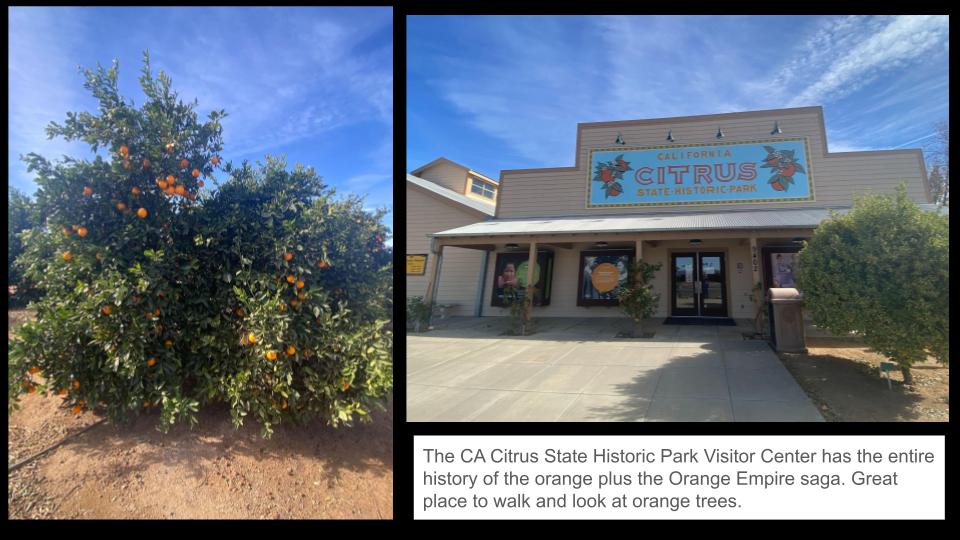
On the road exiting the park, a roadside stand sells the navel oranges that are grown on the park’s trees and they are incredible. Plus, there is a giant orange for the perfect Instagram picture.
Visit the Historic Mission Inn
Frank Miller realized the tourism potential of a grand hotel in Riverside so he constructed the Mission Inn, which has been beautifully preserved and renovated. My blog Retro Road Trip Historic Mission Inn describes it in detail.
In 1903, to build his dream hotel, Frank Miller hired architect Arthur Burnett Benton, who also constructed the historic First Church of Christian Science in Riverside. Both the church and hotel were designed in Mission Revival style. Taking its inspiration from the Spanish missions, Mission Revival style has enclosed courtyards, adobe walls, wide eaves, clay roof tiles, arches, ‘Baroque’ gables and towers.
Then Death of the Orange Empire
The Orange Empire collapsed in the 1950s. The collapse was the combination of several factors. First, war time production across the Southland had drawn workers away from agriculture and into higher paying jobs with aviation and steel companies.
To meet the housing demands of the population boom, tract housing and freeways were built on former agricultural land. In addition, the popularity of the automobile diminished the power and profitability of the railroads.
The final blow was a disease called “quick decline,” which swept through the groves and killed orange and lemon trees. Scientists were unable to develop resistant varieties until the 1960s.
Conclusion
Citrus cultivation drove most of Southern California’s development. Take a road trip to Riverside and squeeze the juice out of the history of the Orange Empire.




Gay says
Fascinating. I knew nothing of the history of the orange in California.