
The Ramona Outdoor Play is filled with spectacle and has been performed for 103 years in the Ramona Bowl in Hemet, California.
The Ramona Bowl is snuggled into the foothills of the San Jacinto Mountains and the performance uses the hillsides as part of the stage. Live music, folklorico dancing, a cast of 375 people and thirteen horses make this play unique.
The Ramona Outdoor Play is performed for three consecutive weekends in mid-April to early May. For the remainder of the year, the Ramona Bowl is used for Concerts Under the Stars. Once a month it holds the Ramona Market with food, music, bar and vendors. In October, it ghost hosts Boo at the Bowl.

Highlights of the Ramona Outdoor Play
In the Ramona Bowl, the landscape is part of the stage. During the show, Alessandro runs up a hillside, cowboys gallop down dirt trails, and Indians shout from the hilltop. Because the play used topography as the setting, it made the history of Southern California come alive.
The weather was moody the day I attended the performance. Clouds, alternated with burning sunlight and chill winds. As if on cue, when the villain cowboy was mentioned, a huge gust of wind blew dust across the stage and, a moment later, he galloped into the scene.
The horses were the highlight of the show–running, galloping and snorting. During the fiesta, one of the horses danced in a circle. There are thirteen horses in the cast and most of their cowboy riders are Hemet locals who participate annually in the show.

Wild birds decided to join the cast! At first you could only hear a red tailed hawk making its distinctive kee-eeeee-arr cry. Then the hawk circled above the bowl. A villainous raven appeared and chased it away. Later, two California quails scurried across the stage.
The play included live music performed on stage by the Arias Troubadours. Traditional Mexican and Spanish music included “Cielito Lindo” and “Las Golondrinas.” At the fiesta, Spanish dancers performed “La Madre del Cordero.” The Temecula Indian Tribe are part of the Cahuilla peoples. The Ramona outdoor play includes their drumming, dancing and Luiseño bird songs (”Ehéngmayum”).
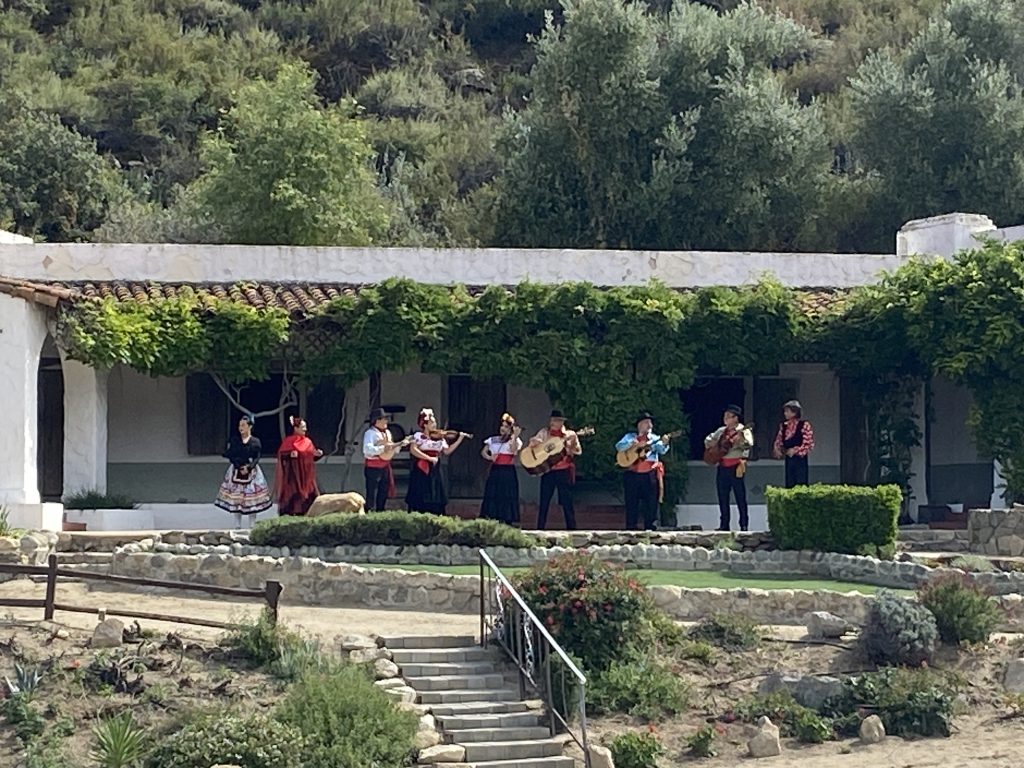
The Ramona Bowl has a museum, gift shop and food vendors. There is also a Ramona Terrace with a sign that says the site was once a Pochea Indian Village. Their peoples died from a smallpox epidemic after the Spanish first passed through in 1774.
Plot Synopsis
Ramona is set in 1850, at the end of the Rancho Era. California had been declared a state, and the Mexican Rancho owners were losing their lands to new Anglo settlers.
The play begins in a Mexican Hacienda on the Moreno Rancho. Trouble comes when a cowboy and his crew arrive claiming to have the title to the land. Although the sword-wielding Señora Moreno drives him away, he vows to return.
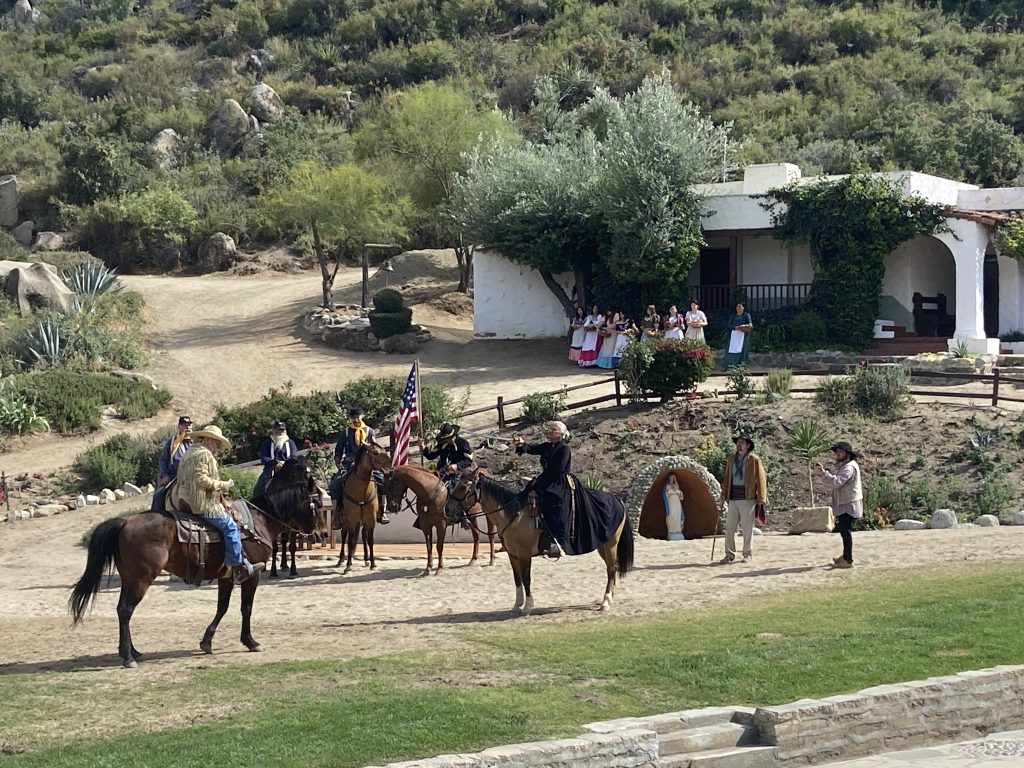
Ramona, the adopted daughter of Señora Moreno, discovers that she is half-white and half-Indian. With this knowledge, she feels free to love Alessandro, an Indian. Despite Señora Moreno’s efforts to stop her, Ramona flees with Alessandro.
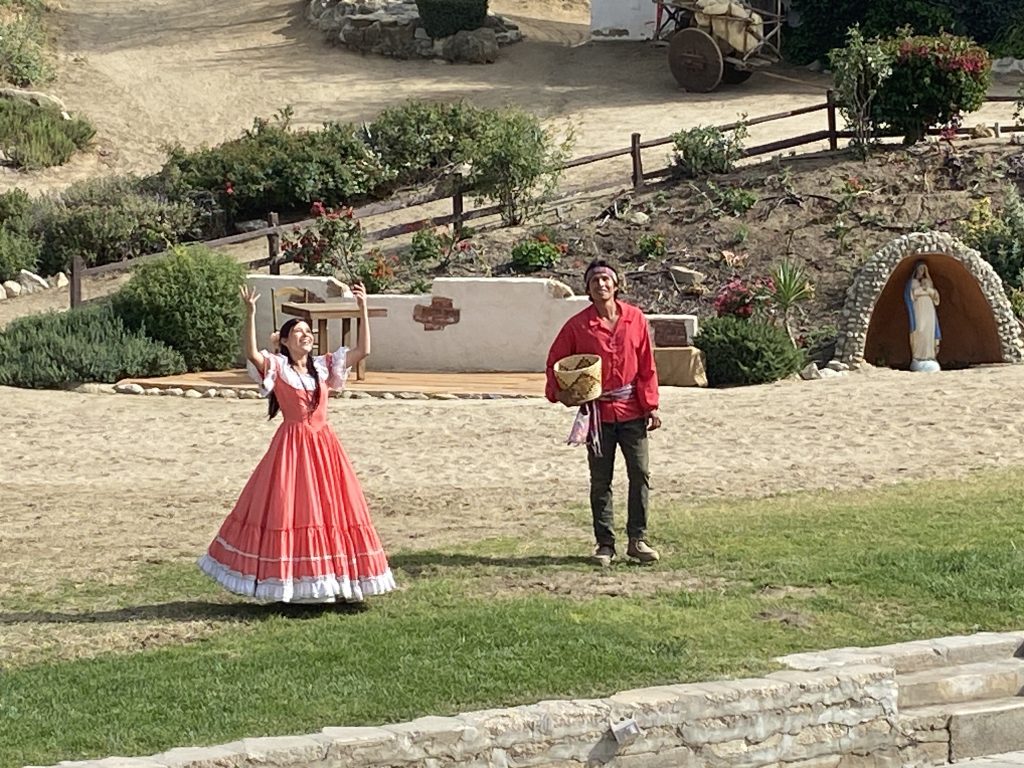
The pair face troubles as the Temecula Indian Tribe is driven from their lands and forced to hide in the wilderness. American “squatters” threaten them in their new home and bring the play to its climax.
Helen Hunt Jackson wrote Ramona to advocate for Native Americans
The play is based on the novel Ramona, by Helen Hunt Jackson (1830-1885). Published in 1884, Jackson wanted to raise the public’s indignation at the government’s treatment of Native Americans. Her goal was to write a book that would have the same impact that Uncle Tom’s Cabin (1852) had on the slavery issue, before the Civil War.
People will read a novel when they will not read serious books.
-Helen Hunt Jackson
Helen Hunt Jackson was already one of the leading women writers of her day. She wrote poems, essays, travel stories and novels. Jackson became an advocate for Native American rights after hearing Ponca chief Standing Bear speak at a forum in New York City in 1879. Standing Bear told of his people’s terrible treatment and the failures and broken promises of the U.S. Government.
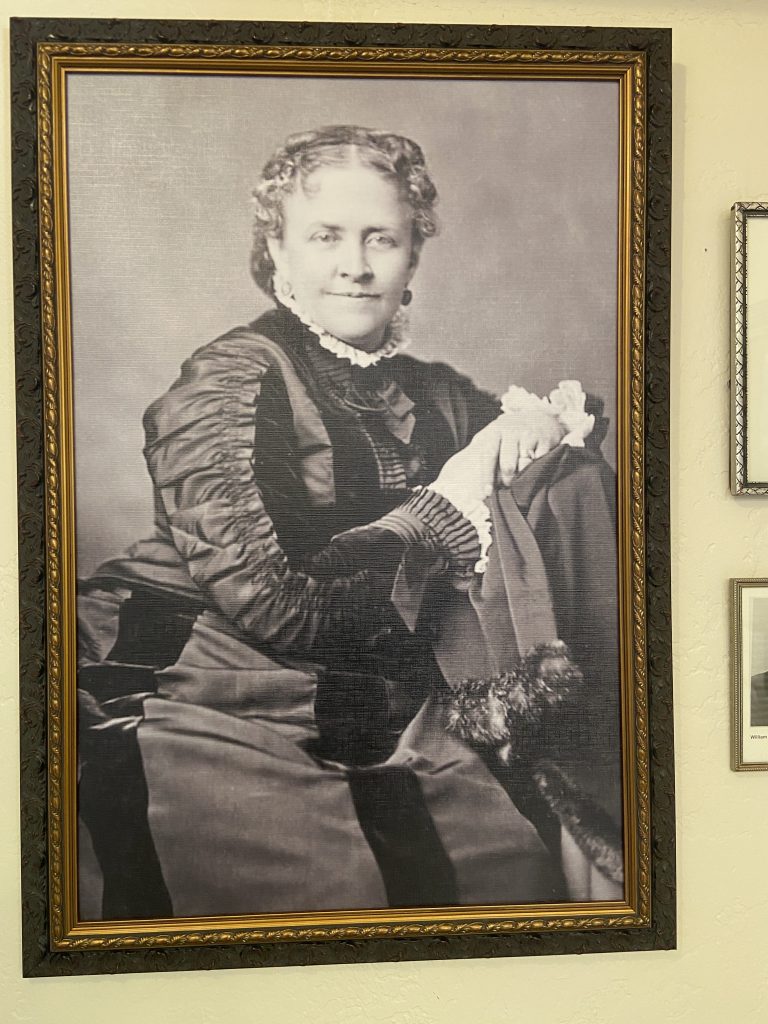
Determined to help, Jackson wrote letters and articles about the abuses suffered by Native Americans. In 1881, she published a non-fiction book, called A Century of Dishonor, and sent a copy to every member of Congress. The U.S. government made her an agent and sent her to Southern California to report on the “conditions and needs” of local tribes.
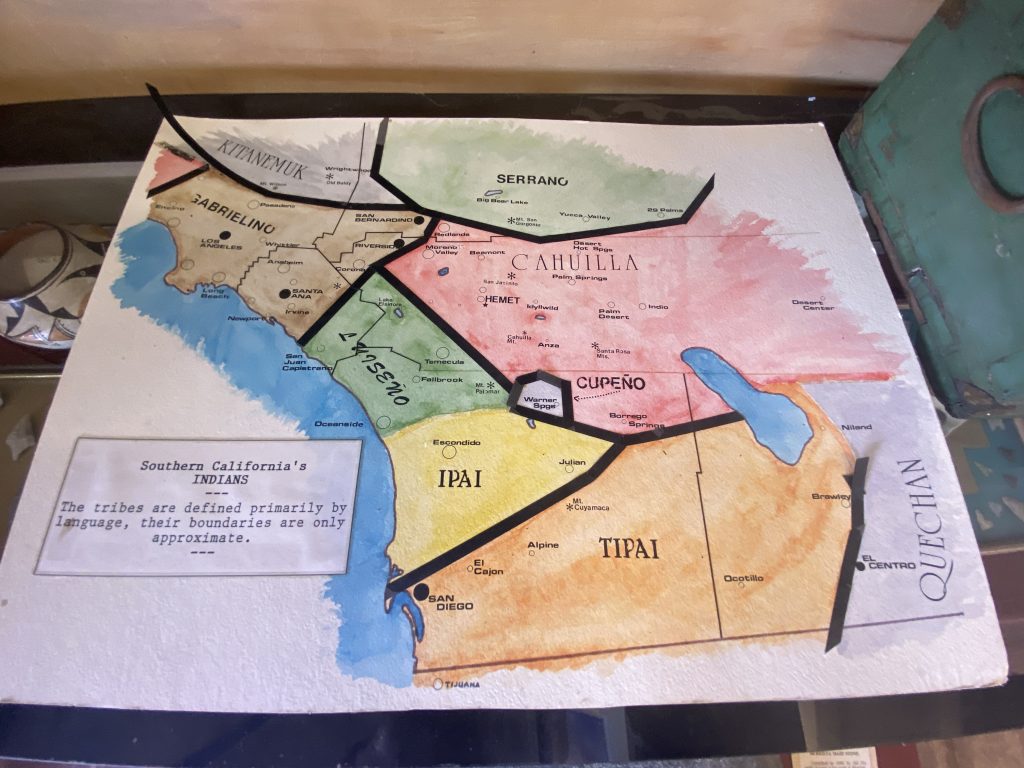
Despite her efforts, Jackson’s cries for justice remained unheard. She decided to write a fictional story loosely based on one she had heard in San Jacinto. “Ramona” Lubo was the widow of Juan Diego, both part of the Soboba Band of Luiseño Indians.
One night, Juan got drunk and accidentally rode the wrong horse home. The owner of the horse, Sam Temple, shot him dead for horse theft. Temple turned himself in to the local Justice of the Peace, but claimed Juan had threatened him with a knife. Ramona, the widow, had witnessed the murder and knew there was no knife. However, she was not allowed to testify because she was an Indian. The murder was ruled as “justifiable homicide” and Temple went unpunished. Helen Hunt Jackson wrote Ramona as a love story to win the hearts of her readers.
Ramona was a Bestseller
The book was a huge success and had over 300 printings. By 1893, Ramona was in sixty-eight percent of America’s public libraries. The Los Angeles Public library owned 105 copies of the book in 1914, and borrowers still had to make a reservation. It was translated into German, French and Spanish.
In 1910, it was made into a silent film starring Mary Pickford. Different films of the Ramona story came out in 1916, 1928, 1936 and 1946. As recently as 2000, it was made into a 74-episode telanovela in Mexico.
The Ramona Outdoor Play was first performed in 1923. The playwright, Garnet Holme, saw the canyon and felt it would be the perfect place to capture the true spirit of Helen Hunt Jackson’s story. The script was updated in 2015, by Steven Savage, to include more action and historical content.
Originally called the Ramona Pageant, it has run every year except 1933 (Great Depression), 1942 (WWII), and 2020 (COVID). In 1993, it was declared California’s official State Outdoor Play.

Ramona created a Cultural Identity for So California
Unfortunately, Jackson’s goal of inspiring justice for the American Indian was not accomplished. However, her romantic portrayal of Mexican Rancho life created a cultural identity for Southern California. Missions, caballeros and bougainvillea draped patios are all images from the novel and became popular in Southern California. The novel also inspired Mission and Spanish Revival architectural styles. San Diego and Los Angeles fought over who had the best case for naming a city Ramona–San Diego won.

The publication of Ramona coincided with the railroads, and they used the book to drum up tourist business. Visitors could take trains to visit the locations in the novel. The Ramona Bowl has a display of all the tourist items for sale in Southern California that reference Ramona, including salt shakers and dolls.
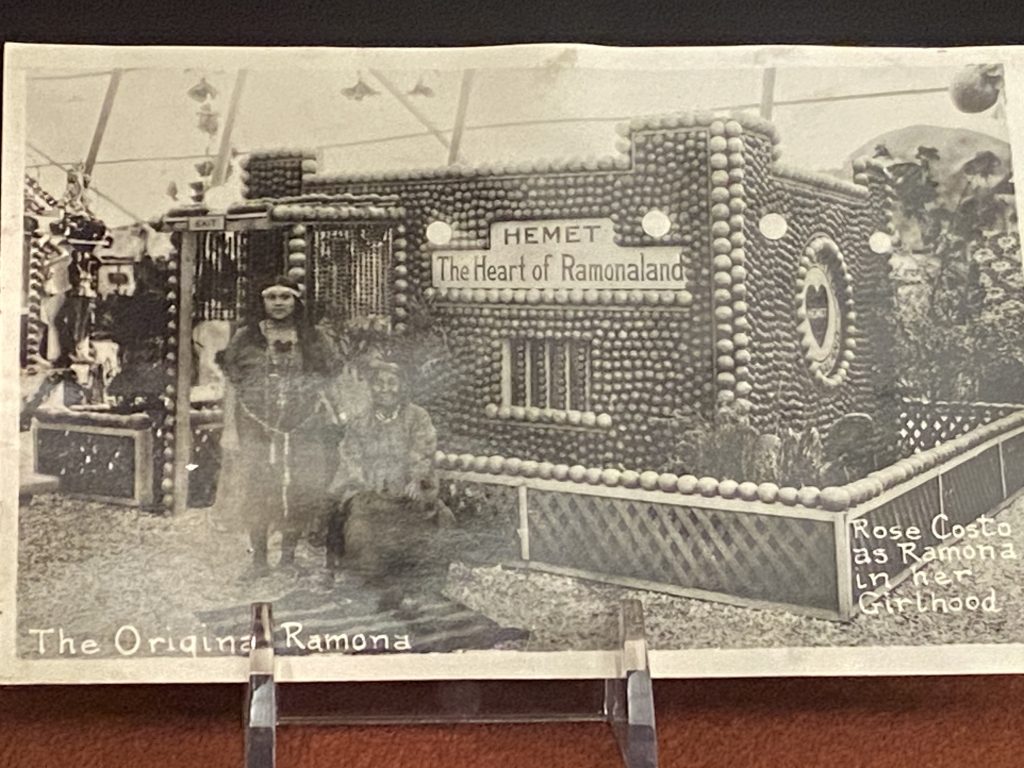
After publication of the novel, the widow “Ramona” Lubo was touted as the “real Ramona.” Writers, photographers and tourists went to her home near Anza to see her. In 1921-22, Hemet-San Jacinto Chamber of Commerce arranged for Lubo to make public appearances at the County Fair and the National Orange Show. Unfortunately, she became sick at the Orange Show and died in July, 1922.
California Missions
In Ramona, Alessandro was raised with an Indian band at the Mission San Luis Rey, in Oceanside. The Mission had been abandoned in 1898 and fallen into disrepair, but tourists traveled to see it. In 1892-1893, Mission San Luis Rey and its grounds were restored.
Missions throughout California began to be restored. Traveling the El Camino Real, a road that connected the missions, became a tourist activity. In 1906, the highway was marked by replicas of Mission Bells.
San Diego Connection
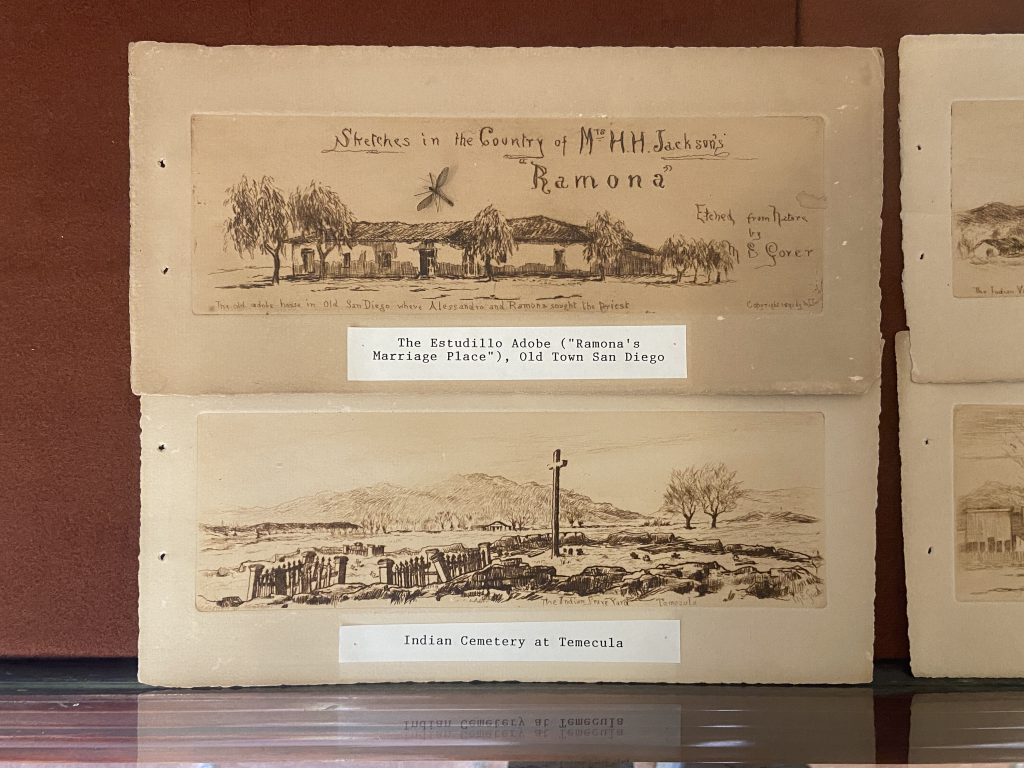
John D. Spreckles decided to use the novel as a way to market San Diego. He purchased the crumbling La Casa de Estudillo in Old Town San Diego.
Built during 1827-1829 by comandante José María Estudillo and his son, the 12-room adobe structure was the center of social and religious life during the Mexican and early American days of San Diego. However, after the Estudillos left in 1887, the house fell into ruin.
Spreckles hired Hazel W. Waterman to renovate the home so it could be billed as Ramona’s Marriage Place. Waterman used the descriptions in the novel to guide her redesign. It was a popular tourist attraction from 1910-1964.


In 1968, La Casa de Estudillo became part of the California State Park system. It was accurately restored to how it looked when the Estudillo family owned it and became a house museum. It is one of the finest examples of a large Mexican adobe townhouse in the U.S. Many preservationists believe that if it weren’t for the popularity of Ramona, the home might not have been saved.
Citrus Labels
Southern California was the home to the Orange Empire and citrus labels featured Ramona, Alessandro and the Mission Friars.

Conclusion
Along with Uncle Tom’s Cabin, by Harriet Beecher Stowe, and Silent Spring, by Rachel Carson, Helen Hunt Jackson’s Ramona takes its place among novels that have shaped American culture.


Leave a Reply